Posts

SOG Game Highlight: Citadels

Image
Every month we will highlight a game or two that has seen play at or will be tabled at SOG. Citadels, first published in 2000 and since released with its expansion, Dark City as a smaller, more transport friendly size was popular in the 2000s. While its popularity has faded, it is still a good game and hold its age well. Not everyone's favourite card game, but if you have five to seven players looking for a game playable in about an hour you could do worse. In Citadels, each player competes to finish building their city, which consist of District cards they play from hand. The last round happens when a player successfully builds eight districts. Points are awarded for completing a city, being first to do so, and the value of your districts. Districts are builded by paying for their cost in gold which varies from one to six or more. Each district also has an associated character; more on this later. The gold are represented by nice plastic tokens that look a bit like cand...

SOG Game Highlight: Iliad

Image
One of the great card games we have at SOG is Iliad, a card game from Asmodee. First published in 2006, Iliad has become a classic and a favoured multi-player card game. In Iliad, which is based on the ancient Greek epic poem of the same name, each player is besieging Troy with the aim of winning sieges to take over Troy (or Helen, we will come to that later) Each player is deal a hand of ten army cards at the start. These army cards consists of hoplite, archers, chariots and various war-machines. Players take turns playing cards and the player with the highest army value at the end of the siege, wins the siege. Starting from the winner and highest army value of each army on the table, the spoils of wars are distributed, with the winner having first pick, followed by he second place, etc. The spoils consist of victory points cards with one negatve victory points card going to the lowest ranked player that siege. Furthermore victory points cards are divided into city and ship ca...

Mythos 0.2

Image
Mythos: The Dramatic Role-playing Game. Image from FFG's Gates of Arkham By and by I will be presenting the role-playing system I use in my games. A role-playing/storytelling system The system is relatively simple and is inspired by The Window , D6 and Risus . It only uses six-sided dice. A skill or trait are ranked in levels and they range from 1-7+. 1              Poor 2              Below Average 3              Average, Mediocre 3+            Competent 4              Above Average, Skilled, Good 4+ 5              Excellent, Very Good 5+ 6              Superb, Remarkable, Master 6+ 7              Grandmaster, Incredible 7+            Unbelievable Most h...

Making a Dice Tray version 2.0

Image
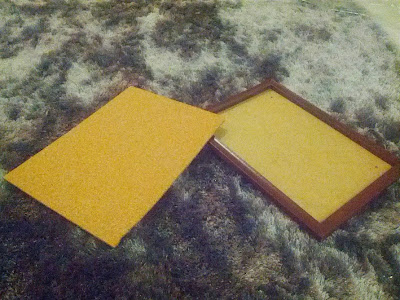
So the previous dice tray worked well, but an unfortunate incident involving mould consigned it to the trash bin. Setting out to make a second one I decided I wanted a deeper tray as well as something more square in shape. The depth especially since while the previous one was adequate for small 12mm d6s, bigger dice have a tendency to careen out of the tray, especially in times of excitement (which is often in my games). This time I used a deep photo frame, a 25cm square Ribba . It is about 4cm deep and only 9.90SGD at the local Ikea. Again I used a cork sheet bought from Artfriend sandwiched where the photo would be and viola. Yet another photo dice tray, this time a deep one. Admittedly somewhat large but nice and deep. Great if you need to roll lots of dice. Total investment this amounts to less than $12. Pretty neat, I like it!

Making a Dice Tray

Image
I have played enough games with enough people to find having an confined area for dice to roll a good thing to have. At the same time it should be aesthetically pleasing. I decided to try my hand at making one. A trip to Daiso turned up a SGD2.00 (~USD1.60) picture frame about A4 in size with enough thickness of frame to hold most throw of the dice yet not hide dice in the corner. Next I bought a cheap cork sheet from Art Friend for less than a dollar, which with a bit of trimming fitted the picture frame nicely where the glass was. Here's a look at the stuff I bought. And here is the completed dice tray along with some dice for comparison. The small dice are 12mm.

Shadows over Angers - Part 5 (The Ending that Never happened)

Image
They made plans to get into the castle that night... And that was it, we never got around to finish what was going to be last part of the scenario before David had to return to the States. Shucks. Still, I had a rollicking fun GMing and I believe the players had a great time as well. I am going to use this post to to reflect on the game and what went right, what went wrong. 1. Simulation vs the dramatic Early in the game I fail to do what I preach; roll only when it is dramatic to do so. When David's character, Pierre was attempting to fix his vehicle, I got him to roll dice to see if he succeeds. It was utterly unnecessary. Fixing the motor was not a dramatic moment in the scene. The only reason the motor failed in the first place was highlight how vehicles are not as reliable as the players might expect and to provide an opportunity for the other characters to chat with Pierre out of the scene for a bit. I remember mentally kicking myself when I reviewed the scene af...

Mythos version 0.1

Previous versions of the rules, used for Shadows over Angers up till Part 4. By and by I will be presenting the role-playing system I use in my games. A role-playing/storytelling system The system is relatively simple and is inspired by The Window , D6 and Risus . It only uses six-sided dice. An attribute, characteristic typically range from 1-7+. 1   Poor (10) 2   Below Average (20) 3   Average, Mediocre (28) 3+ Competent (36) 4   Above Average, Skilled (44) 4+ Professional, Talented (52) 5   Excellent, Very Good (60) 5+ Expert (68) 6   Superb, Remarkable, (76) 6+ Amazing (84) 7   Grandmaster, Incredible (92) 7+ Unbelievable (100) The numbers in round brackets indicates a suggested equivalent value in a percentile system. This may be useful in converting characters from other systems to URPS. Every system is different and you should try to work out what makes sense in each. From time to time ...